WaterColor Buyer Phases: Find the Right Fit
July 9, 2026
July 9, 2026
If you are looking at WaterColor, the phase matters more than many buyers expect. Two homes can share the same community name but offer a very different day-to-day experience based on where they sit, what design rules apply, and how close they are to the amenities you plan to use most. Understanding those differences can help you narrow your search faster and buy with more confidence. Let’s dive in.
WaterColor is a 499-acre master-planned community on 30A, and the community says nearly half of its land is devoted to common and natural areas. That scale is part of what makes the neighborhood appealing, but it also means WaterColor is not one uniform experience from street to street.
The phase system helps explain that variation. In WaterColor, phases are not just a way to describe when an area was developed. They also connect to neighborhood clusters, home size rules, lot orientation, parking expectations, and how close you are to places like the Beach Club, Camp WaterColor, Town Center, Cerulean Park, and the Boathouse.
A current community map shows estimated phase sizes of 68.36 acres for Phase 1, 73.73 acres for Phase 2, 67.93 acres for Phase 3, 51.66 acres for Phase 4, and 8.67 acres for Phase 5. Even so, buyers should be careful about relying on a phase nickname alone because the official map separates neighborhood names from phase boundaries. In practice, you want to verify the exact street and lot before drawing conclusions.
WaterColor’s official map lays out the main amenity spine across the community. Key destinations include the Beach Club, WaterColor Inn, Fish Out of Water, the Boathouse, Camp WaterColor, the Tennis Center, Cerulean Park, and Town Center.
That layout matters because your location inside the community shapes how you will move through it. Some homes place you closer to the beachfront and commercial core, while others connect more to trails, parks, pools, and internal residential streets.
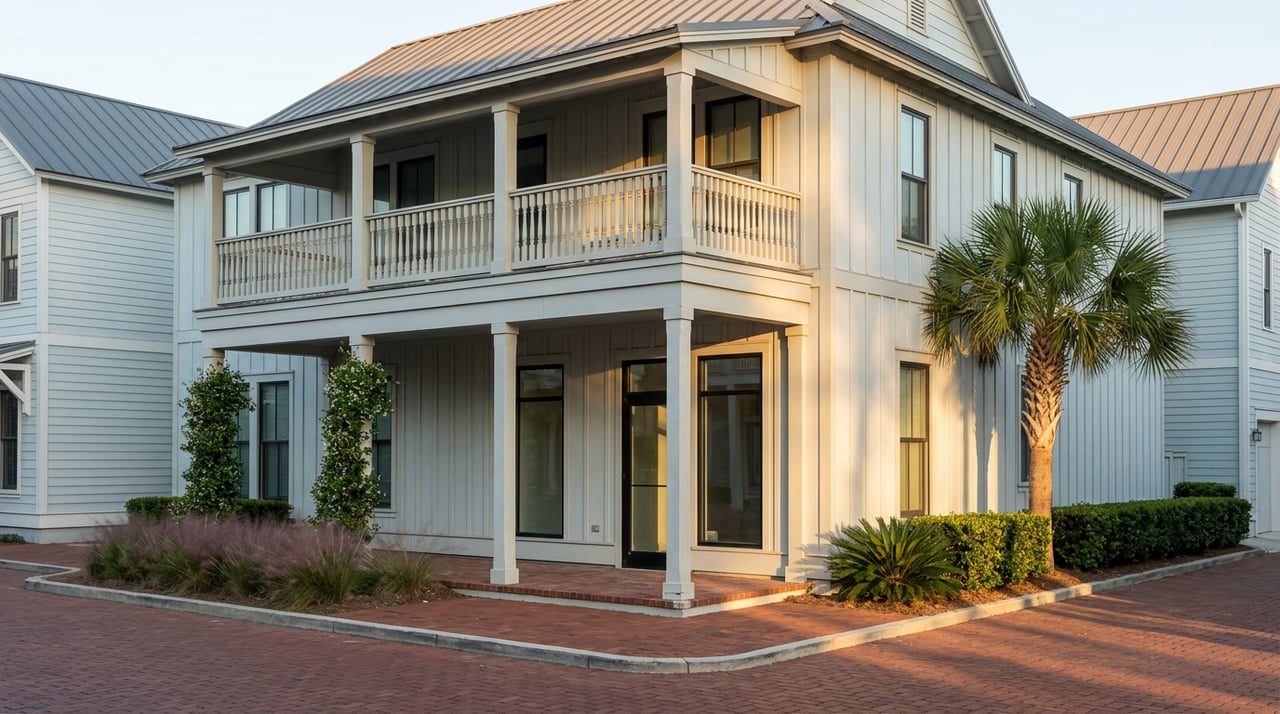
The design rules also vary by phase. WaterColor’s design review framework is rooted in American Coastal and Florida vernacular traditions, and the community requires approval for exterior changes, landscaping, and many other modifications. Even the approved color approach can be tied to a property’s setting, and trim colors cannot be stark white.
Phase 1 is the original southwestern portion of WaterColor, located south of Western Lake. According to an official naturalist report, this phase includes residential properties, community amenities, retail shops, and a beachfront resort.
The same report notes that the western part of Phase 1 is also called the Park District, while the eastern part is known as the Cottage District. On the community map, the original core also includes districts such as Town Center, Park Row, Sunset Ridge, Rose Garden Mews, the Lake District, Rainbow Row, Sunrise Ridge, the Tennis District, and Beach Lane.
If you want the strongest walkable, resort-oriented lifestyle inside WaterColor, Phase 1 is often the clearest fit. Based on the map and amenity locations, this is the phase most closely tied to the Beach Club, Town Center, Cerulean Park, and the beachfront side of the community.
For many buyers, that means easier access to the most visible lifestyle features. If you picture morning coffee near Town Center, beach-focused days, and quick trips to major amenities, Phase 1 deserves close attention.
The Phase II design guide covers Pine Ridge, Lake Forest, Eastern Cove, Cinnamon Fern, and Mere Ridge. In Pine Ridge, the guide allows 1.5- to 2.5-story or 2- to 2.5-story homes depending on lot type, prohibits towers, permits cupolas and widow’s walks, and uses muted and sand-tone palettes for different lot clusters.
The guide also says the main body of the house does not have to sit in the front facade zone in the same way it does in parts of the earlier core. That seemingly small rule can affect how homes relate to the street and how the streetscape feels overall.
Phase 2 reads as more inward and residential than the beach core. On the official map, these neighborhoods sit away from the beachfront side and closer to WaterColor’s internal amenity network, which suggests a quieter, more tree-oriented setting.
If you want access to WaterColor’s amenities but do not need to be steps from the Gulf-facing core, Phase 2 may be a strong match. Buyers often like this type of setting when they want a balance between activity and a more tucked-away home base.
The Phase III guide covers Pine Crest, Cypress Cove, Sandy Creek, Oak Grove, Cerulean Landing, Wiregrass Meadows, Sand Hill, Long Leaf Park, and Vermilion Point. The guide says Phase III continues the traditional patterns of the first two phases while adding rear-view facade zones on lots facing natural areas and community paths.
In Pine Crest, three house types are defined, and towers are vigorously encouraged on Lots 1 and 34. More broadly, the phase introduces a stronger relationship between homes and preserved areas, paths, and varied lot conditions.
For buyers, Phase 3 can offer more variety in lot geometry and how a home sits on the site. That can create a more landscape-driven feel, especially if you value a connection to natural areas rather than a layout focused only on the street.
This phase can be appealing if you want something that feels a bit more custom in orientation while still staying inside the broader WaterColor system. It is worth reviewing the exact lot carefully here because the site relationship can vary more from one property to the next.
Phase 4 includes Summersweet Place, Turtle Ridge, and Cedar Woods. The Summersweet guide says the phase continues the traditional WaterColor pattern language, with most lots limited to 1.5- to 2.5-story homes and some lots allowing 2- to 2.5-story homes.
It also varies front orientation by street or common area, and setback and parking rules change by lot group. The separate Turtle Ridge and Cedar Woods guide says those neighborhoods continue the traditional WaterColor style, with 1.5- to 2.5-story homes, full-facade porches, and specific setback requirements.
Phase 4 feels more plan-driven and residential based on its design rules and map placement. Compared with the beachside core, it generally reads as less centered on resort activity and more centered on a consistent neighborhood environment.
That can be attractive if you want a quieter home base and appreciate strong design continuity. Buyers who care about a more predictable residential setting often find this phase worth considering.
The Phase V guide is titled Park District and says it continues WaterColor’s traditional patterns while tightening lot and parking rules. It allows 1.5- to 2.5-story homes, does not allow a rear-view facade zone, and does not permit widow’s walks or roof-level decks.
Parking standards are especially explicit in Phase 5, including minimum parking counts based on bedroom count and encouragement of double-track drives. The community also states that the Phase V Pool at 155 Climbing Rose Way is a homeowner-only pool.
Phase 5 appears to be the most residential and tightly regulated of the phases covered here. For some buyers, that is a real advantage.
If you prioritize privacy, order, and a less transient environment over immediate resort foot traffic, Phase 5 may stand out. The homeowner-only pool and more defined parking and design rules help reinforce that identity.
Amenities are a big part of the WaterColor buying decision, but they affect phases differently. WaterColor says the community includes 10 pools, five clay tennis courts, two pickleball courts, a bocce ball court, a half basketball court, a soccer field, a playground, five miles of hiking and biking trails, four piers and a dock on Western Lake, five park areas, an outdoor amphitheater, and gardens.
The community FAQ also says homeowner-only beach access is available via Van Ness Beach Access. For buyers who plan to use the beach regularly, it helps to understand both where your home sits and how your access points fit into your routine.
The Beach Club is the only beachfront clubhouse pool available to rental guests along 30A, and the visitor information says it offers three pools, food and beverage options, towel service, and cabanas. Camp WaterColor, which opened in March 2019, includes pools, slides, a lazy river, dining, and basketball.
WaterColor also offers a free trolley with on-demand, point-to-point rides anywhere in the community. That service can reduce some location friction, but it does not erase the practical difference between being near the beachfront core and living deeper in the neighborhood network.
Parking policy can shape the ownership experience more than buyers expect. The HOA says rental guests must pay seasonal parking at the Beach Club, Camp WaterColor, and WaterColor Boulevard South, while homeowners can park free in those paid-parking locations with the proper credential.
If you are buying for personal use, occasional guests, or a hybrid plan, those rules are worth reviewing early. They affect convenience, especially during busy seasons.
Rental use also deserves a closer look. WaterColor requires short-term rentals of less than six months to register through its rental portal, and any exterior change must go through the Design Review Board.
For analytical buyers, the main takeaway is simple: phase alone is not enough. You also want to verify rental eligibility, parking rules, amenity access, and design restrictions at the specific property level.
If your goal is a beach-and-resort lifestyle, Phase 1 is usually the clearest starting point. Its location near the beachfront core, Town Center, and major amenities supports that use pattern.
If you want a quieter residential feel while staying connected to amenities like Camp WaterColor, trails, and neighborhood pools, Phase 2 or parts of Phase 3 may offer a better balance. These areas tend to make sense for buyers who want activity nearby without being in the middle of the beachfront core.
If you prefer a more regulated, lower-traffic environment, Phase 4 or Phase 5 often lines up better. Their design rules and overall placement suggest a more residential day-to-day experience.
WaterColor phases shape buyer options in four main ways: where the home sits, what kind of house can be built there, how close you are to key amenities, and how much day-to-day traffic and rule complexity you are comfortable with. That is why two homes with similar price points can feel very different in practice.
The right choice usually comes down to how you plan to use the property. If you want help comparing streets, amenity proximity, design constraints, and ownership tradeoffs inside WaterColor, the team at Enslen Coastal Group can help you evaluate the details with clarity.
Stay up to date on the latest real estate trends.
Get In Touch With Our Team To Learn More